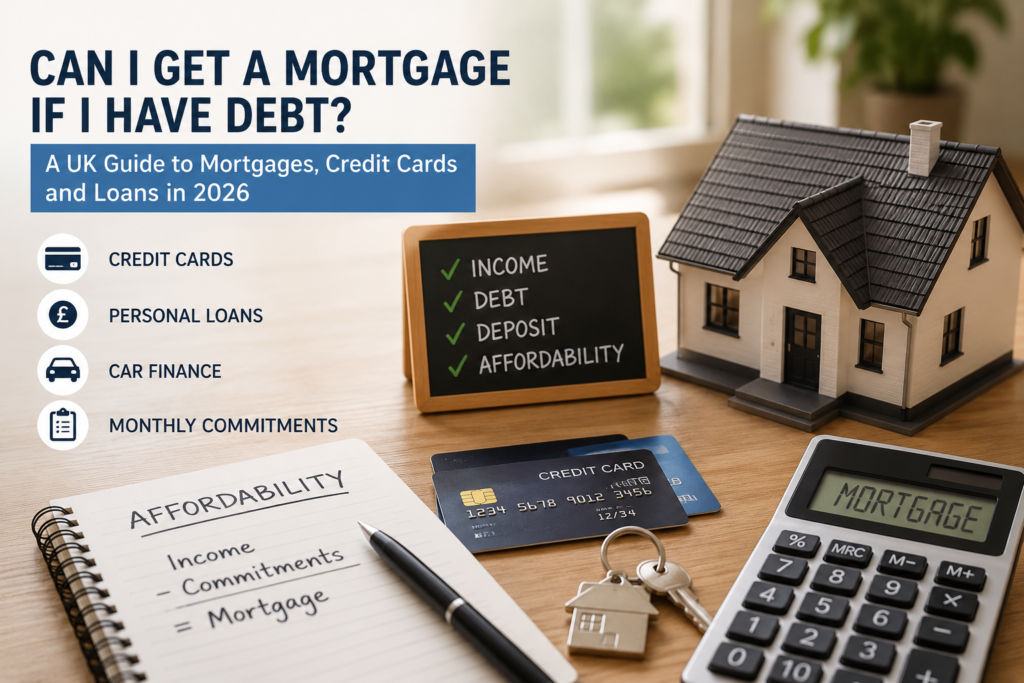
Can I get a mortgage with debt? In many cases, yes. If you’ve got credit cards, personal loans, car finance or other borrowing, you may be worried it could get in the way of a mortgage. You’re not alone. For many UK borrowers, whether they’re buying their first home, moving, remortgaging or investing in a rental property, existing debt is one of the biggest worries when it comes to getting a mortgage.
The good news is that having debt doesn’t automatically rule you out. What matters more is how that debt fits into your wider financial picture, since it can affect your affordability, how much you can borrow and which lenders are likely to consider your application.
There isn’t one rule that applies to every borrower or every lender. The real question isn’t “do I have debt?” It’s “can I afford this mortgage alongside what I’m already paying out each month?”
Can I Get a Mortgage With Debt and Still Pass Affordability Checks?
When you apply for a mortgage, lenders look at your overall financial circumstances rather than just your salary. That typically includes:
Your income
Existing loans
Credit card balances
Car finance
Monthly financial commitments
Household expenditure
Your deposit
Your credit history
The mortgage amount you’re requesting
The property you want to buy
The lender’s own affordability criteria
Two people earning exactly the same salary can end up with very different borrowing capacities once all of this is taken into account. For example, imagine two people who both earn £50,000 a year.
Borrower A has limited existing borrowing and around £200 a month in loan commitments.
Borrower B has a credit card balance, a personal loan, £400 a month in car finance and some other regular commitments.
Despite identical incomes, their mortgage affordability could look very different. This is why a simple income multiple, or an online calculator on its own, can’t tell you exactly what a lender will agree to lend.
If you want to explore the figures yourself, our Mortgage, Stamp Duty and Buy-to-Let Calculators can give you an initial indication. They’re a starting point only, not a mortgage offer or a guarantee of borrowing.
Can I Get a Mortgage With Credit Card Debt?
Potentially, yes. Having a credit card doesn’t automatically stand in your way, though the lender is likely to factor in your outstanding balance and monthly payments when assessing affordability, alongside your income, other commitments, credit history and whether payments have been kept up to date. Someone with a modest, well managed balance is often in a very different position from someone carrying significant unsecured debt with a history of missed payments, even if the raw numbers look similar on paper.
Do You Need to Clear Your Credit Cards Before Applying?
Not necessarily, and it depends on your circumstances. Using savings to clear a card can reduce your monthly outgoings, but it also reduces the deposit you have available. It’s worth understanding that trade-off before making changes to your finances.
Can I Get a Mortgage With a Personal Loan?
Generally, yes. A personal loan won’t automatically lead to a decline, but the monthly repayment is another commitment a lender will take into account. If you’re currently paying £400 a month towards a loan, that reduces the disposable income available for a mortgage payment. The same logic applies to car finance, hire purchase, overdrafts and other regular borrowing. Different lenders weigh these differently, which is exactly why lender selection matters.
Can I Get a Mortgage With Car Finance?
Car finance doesn’t rule out a mortgage either, but the monthly payment is taken into account in the same way as any other commitment. A borrower paying £450 a month for their car will typically have a different affordability position from someone on the same income with no car finance at all.
Should You Pay Off Your Car Finance First?
Not automatically. Clearing the finance could free up some monthly income, but think about where that money is coming from, and whether using it would eat into your deposit or your emergency savings. There’s no single right answer here.
Should I Pay Off My Debts Before Applying for a Mortgage?
This is one of the most important questions to get right. It’s tempting to think “I’ll just use my savings to clear everything before I apply.” Sometimes that does improve your position. It isn’t automatically the right call.
Say you have £30,000 in savings and £10,000 of outstanding borrowing. You could use £10,000 to clear the debt, leaving £20,000 towards your deposit. Or you could keep the full £30,000 deposit and carry on making your existing repayments.
Which is better depends on your circumstances. Clearing the debt can reduce your monthly commitments and improve affordability. But a smaller deposit increases your loan-to-value, which can affect which mortgage products are available to you. It’s worth looking at the whole picture before making a decision this significant.
Can I Get a Mortgage With Debt If I Have a Small Deposit?
Potentially, yes, though the combination of a smaller deposit, meaningful unsecured debt, high monthly commitments and a lower income can narrow your options. That doesn’t mean a mortgage is off the table. It means lender selection and a proper affordability assessment matter more than usual.
What If I Have Bad Credit and Debt?
Adverse credit alongside existing debt makes things more complicated, but it doesn’t automatically rule you out. What matters is the detail: missed payments, defaults, County Court Judgments, mortgage arrears or a debt management arrangement, how long ago it happened, whether it’s been settled, and your current financial position, deposit, income and commitments.
Not every lender applies the same criteria, which matters most if you’ve had financial difficulties in the past. Rather than assuming a mortgage isn’t possible, it’s worth establishing what’s realistically available before making multiple applications, since several declined applications in a short space of time can affect your credit file.
Can I Get a Mortgage If I’m Self-Employed and Have Debt?
Potentially, yes. Being self-employed with existing debt doesn’t rule out a mortgage, though your income will usually need to be evidenced differently from an employed applicant’s. Depending on your circumstances, a lender may ask for SA302s or tax calculations, tax year overviews, company accounts, and business and personal bank statements, along with other evidence of ongoing income. Your personal and business commitments will both be considered, so it’s worth getting your paperwork in order before you apply.
How Much Can I Borrow If I Have Debt?
There’s no single, universal answer. You may have heard that lenders will lend a certain multiple of your income, but that’s only part of the picture. What you can borrow is really shaped by your income, deposit, expenditure, existing debt, credit history, the lender’s criteria and the mortgage itself, taken together.
That’s why two applicants on the same salary can end up with different outcomes. If you want an initial indication of potential payments and borrowing, the Mortgage Calculator gives you a starting point, for guidance only.
Can I Consolidate My Debts Into My Mortgage?
In some circumstances, yes, this can be an option. A homeowner may look at increasing their mortgage borrowing to repay existing debts, which can reduce the number of monthly payments they’re juggling. It needs careful thought, though.
A lower monthly payment doesn’t automatically mean a cheaper solution. If unsecured borrowing is moved onto a mortgage and repaid over a much longer term, you could end up paying more interest overall, even though the monthly figure looks smaller. There’s also an important distinction between unsecured and secured borrowing: once debt is consolidated into your mortgage, it’s secured against your property.
Think carefully before securing other debts against your home. Your home may be repossessed if you do not keep up repayments on a mortgage or other loan secured on it.
If you’re experiencing financial difficulties, it’s worth seeking proper debt advice rather than assuming that increasing your mortgage is automatically the answer.
What If I Already Have a Mortgage and Lots of Debt?
This is a live issue for a lot of UK homeowners. You might currently have a residential mortgage alongside credit card balances, personal loans, car finance and other borrowing, with your current deal coming to an end. The question that matters is whether you can afford your new mortgage payment while still servicing everything else.
Outstanding UK residential mortgage lending reached approximately £1.746 trillion in Q1 2026, according to the FCA. For anyone approaching the end of a fixed rate, reviewing your position early is worth doing.
When Should I Start Looking at My Remortgage?
Don’t wait until your current deal expires. Most borrowers start reviewing their options several months beforehand, which gives you time to check your credit file, review your finances and existing debts, understand your affordability, look at your equity position and explore what’s out there. If your deal is coming to an end, speaking to an adviser early gives you more room to plan.
What About Buy-to-Let Mortgages and Debt?
If you’re considering an investment property, your existing personal debt is still relevant. A buy-to-let mortgage is assessed differently from a residential one, with expected rental income forming an important part of the lender’s decision, but your personal circumstances, existing commitments and deposit still matter. Our Buy-to-Let Calculator can help you explore potential payments, rental income and coverage requirements before you start looking seriously.
Calculator results are indicative only and don’t constitute a mortgage offer or a guarantee that a lender will accept an application.
Don’t Forget Stamp Duty When Calculating Your Budget
Your deposit isn’t the only upfront cost. Depending on the property and your circumstances, you may also need to budget for Stamp Duty Land Tax, mortgage costs, legal fees, valuation and survey costs, moving costs and other property related expenses. Our Stamp Duty Calculator can help you estimate what you might owe, checked against the latest government rules for your situation.
What Is the FCA Doing About Mortgage Affordability?
The mortgage market keeps evolving. In June 2026, the FCA published a consultation, CP26/18, Mortgage Rule Review: Responsible Lending, proposing changes to its lending rules, aimed at helping more creditworthy consumers access suitable mortgages while keeping responsible lending and affordability requirements in place. The proposals touch on borrowers with variable or irregular income and some previous credit difficulties. These are proposals, not rules that are already in force. Read the FCA’s consultation paper.
What Should I Do Before Applying for a Mortgage With Debt?
If you’re considering a mortgage while carrying debt, a bit of preparation goes a long way.
1. Check your credit reports. Make sure the information held about you is accurate.
2. List all your debts. Credit cards, personal loans, car finance, overdrafts and anything else, with the outstanding balance and monthly repayment for each.
3. Review your monthly expenditure. Understanding where your money goes helps you spot potential affordability issues early.
4. Avoid unnecessary new borrowing. Taking on new credit shortly before applying can affect your overall position.
5. Don’t automatically clear your debts. Think through how using savings to repay borrowing affects your deposit and affordability before you do it.
6. Don’t assume your situation is impossible. Lenders’ criteria vary considerably.
7. Use our calculators. They can help you understand the potential costs and figures before making a major financial decision. View all of our calculators.
8. Consider professional mortgage advice. An adviser can look at your circumstances properly and help you understand which options are worth exploring.
The Biggest Mistake Borrowers With Debt Can Make
It’s easy to assume “I have debt, so I won’t qualify.” That’s not necessarily true. But the opposite assumption, “I’ll just consolidate everything into my mortgage and reduce my payments,” can be just as risky, and isn’t automatically the right solution either.
Your income, deposit, existing debts, monthly expenditure, credit history, mortgage requirements and the lender’s own criteria all form part of the bigger picture, and need to be considered together rather than in isolation.
Worried Your Debt Could Affect Your Mortgage?
If you’ve got credit cards, personal loans, car finance or other borrowing, don’t automatically assume you won’t qualify for a mortgage, and don’t rush to clear or consolidate your debts without first understanding the consequences.
At Templar Mortgages and Protection, we can review your circumstances and help you understand what may be achievable, what could affect your affordability, and what options might be available to you, whether you’re:
Buying your first home
Moving home
Looking to remortgage
Managing existing debt
Considering debt consolidation
Looking at a buy-to-let investment
Self-employed
Concerned about mortgage affordability
Your circumstances are unique. Your mortgage advice should be too.
Contact Templar Mortgages and Protection today to discuss your mortgage requirements.
Frequently Asked Questions
Can I get a mortgage if I have debt?
Usually, yes. Existing debt doesn’t automatically prevent you from getting a mortgage, though your financial commitments can affect affordability and how much you’re able to borrow.
Can I get a mortgage with credit card debt?
In most cases, yes. Lenders typically look at your outstanding balance and monthly payments as part of the affordability assessment.
Can I get a mortgage with a personal loan?
Generally, yes. The monthly repayment on your loan is usually factored into how your mortgage affordability is calculated.
Should I pay off my debts before applying for a mortgage?
Not necessarily. Clearing debt can reduce your monthly commitments, but using savings to do it may reduce your deposit. The right approach depends on your individual circumstances.
Can I get a mortgage with bad credit and debt?
It depends on the nature, severity and age of the adverse credit, your current financial position and which lenders are available to you.
Can I consolidate my debts into my mortgage?
In some circumstances, yes. But it can increase the amount secured against your home and may mean paying more interest over the longer term, so it’s worth thinking through carefully.
Can I remortgage if I have lots of debt?
Usually, yes. Your existing borrowing will generally form part of the affordability assessment, and the right solution depends on your circumstances and which lenders are available.
Can I get a buy-to-let mortgage if I already have debt?
Potentially. Buy-to-let lending is assessed differently from a residential mortgage, with expected rental income playing an important part, alongside your wider financial circumstances and the lender’s own criteria.
How much can I borrow if I have debt?
There’s no universal figure. Lenders consider income, expenditure, existing commitments, deposit, credit history and their own affordability criteria together.
Use Our Mortgage, Stamp Duty and Buy-to-Let Calculators
Before you make your next move, it’s worth exploring the figures using our specialist calculators.
Mortgage Calculator – explore potential mortgage payments and borrowing requirements based on the figures you enter.
Stamp Duty Calculator – estimate the potential Stamp Duty Land Tax payable on your property purchase.
Buy-to-Let Calculator – explore potential buy-to-let mortgage payments, rental income and coverage requirements when you’re considering a property investment.
Explore all of our calculators
Our calculators are provided for guidance and illustration only. The results aren’t a mortgage offer or a guarantee of borrowing. Your actual affordability, eligibility, interest rate and borrowing capacity will depend on your individual circumstances and the criteria of the lender.